Thermal Scope Battery Life in Cold Weather: How to Make Your Batteries Last All Season

Legal and safety disclaimer: This article provides only general and high-level explanations for educational purposes. It is not legal advice, technical advice for your specific device, or a substitute for the manufacturer’s instructions. Laws and hunting regulations may vary by location and circumstance; you are responsible for understanding and complying with the rules that apply to you. Do not rely on this content as legal advice. For guidance about your specific circumstances, consult qualified legal counsel and your device manufacturer.
When late-season temperatures drop, battery life can become less predictable. Your thermal scope may show a quickly falling battery indicator or shut down sooner than it did during a mild-weather range session. That doesn’t necessarily mean the battery has failed: cold can temporarily reduce the power a battery can deliver.
A little advance planning can make a difference during long sits and early starts. Here’s what may be happening, what you can check, and how to prepare, without treating any tip as a replacement for your scope’s manual.
Why cold can shorten runtime
Many modern optics use lithium-ion (Li-ion) batteries. In cold conditions, the chemical processes inside a Li-ion battery generally slow down and its internal resistance may increase. Under the scope’s electrical load, voltage can dip sooner, so the device may indicate low power or reach its shutdown threshold even though some energy remains available once the battery warms.
The exact effect depends on the battery, temperature, device, and power demand. A thermal scope with its display, recording, wireless features, or other functions active may draw power differently from one used with fewer features running. As a result, there is no single winter-runtime estimate that applies to every model or hunt.
A useful example comes from the Pulsar Thermion 2 XG50 manual. It lists up to 10 hours of operating time at 22°C (about 72°F) for specified battery packs, while noting that actual runtime depends in part on Wi-Fi and video-recorder use. The same manual says battery capacity decreases below freezing and identifies this as normal for that battery pack. That room-temperature figure is not a cold-weather guarantee, and it should not be assumed to apply to other models.

What you can check before your hunt
Start with the operating, storage, and charging guidance for your exact scope and battery. Those limits are not interchangeable: a scope may be rated to operate in conditions that are outside the battery’s permitted charging range.
Check whether the manual specifies battery type, temperature limits, charging instructions, and any recommended storage level. For example, the Pulsar manual says to charge the covered battery pack between 0°C and 45°C (32°F and 113°F), and to store it at a partial charge of 50% to 80% for long-term storage. Treat those figures as model-specific, not universal battery rules.
If you use an external battery pack, confirm it is compatible with your optic and appropriate for the expected environment. Keep connectors clean and dry, and look for damage before use. If the battery or device behaves unusually, follow the manufacturer’s troubleshooting and service guidance rather than trying an improvised repair.
Generally speaking, checking these details before the season is easier than figuring them out in the dark, and much, much more.
Keep spare batteries warm and protected
A practical cold-weather habit is to carry spare batteries close to your body, such as in a secure inner pocket or insulated pouch. Keeping a spare warm may help it deliver power more reliably than leaving it exposed to freezing air. Protect it from moisture, dirt, and accidental contact with metal objects that could bridge the terminals.
If your scope uses replaceable batteries, rotating a warm spare into use may help you manage a long outing. Follow your manual’s battery-change procedure, and avoid forcing a pack into place. For models with built-in batteries, check whether the manufacturer supports an external power source and which accessories are approved.
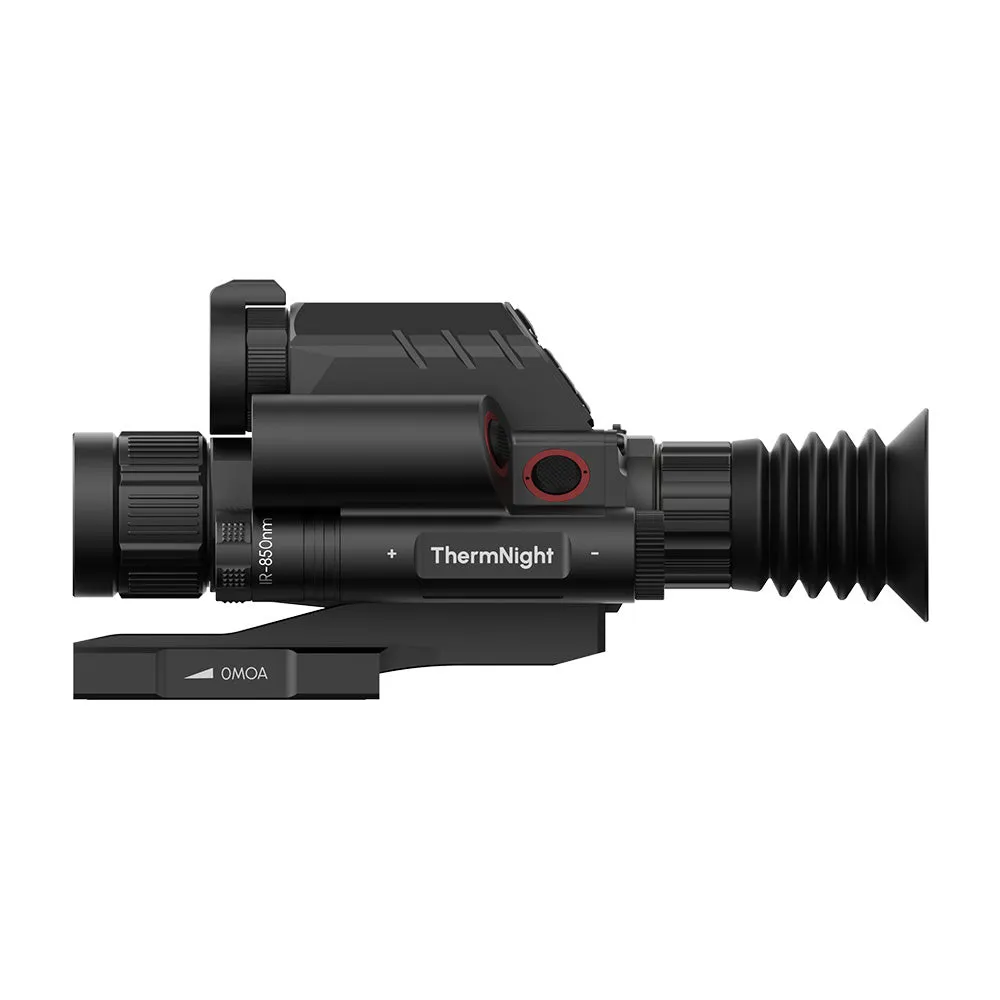
AnyTime Optics carries thermal and night-vision optics, including the DNT ThermNight TNC225R, as well as compact thermal options. If you’re comparing models for late-season use, battery design and charging instructions are worth checking alongside size, features, and price. A compact thermal scope can be easier to carry, but compact size alone doesn’t tell you how long a particular unit will run in the cold.
Reduce unnecessary power draw
You don’t necessarily need every feature running throughout a hunt. Where your manual allows, consider switching off wireless connections, recording, or other functions when you aren’t using them. Lowering display brightness to a comfortable level or using an available power-saving setting may also help, depending on the model.
Treat these as options to test at home or during a permitted practice session, not last-minute changes to make while you need the optic. Learn the controls before heading out, and note which settings make the most difference on your unit. A scope’s standby or display-off mode may not turn the device fully off, so check what remains active.

Charge and warm batteries carefully
Avoid assuming that a cold battery is ready to charge just because the scope can operate in cold weather. The Pulsar manual, for example, gives a charging range of 0°C to 45°C for its specified packs and cautions against charging immediately after bringing a pack in from the cold. Other batteries may have different limits, so check the instructions that apply to yours.
When a battery comes in from freezing conditions, allow it to return gradually to the manufacturer’s permitted charging temperature. Don’t place it against a heater, on a hot surface, or near an open flame. If it is wet, damaged, swollen, or unusually warm, don’t charge or use it until you have consulted the manufacturer’s safety guidance.
Cold equipment brought indoors may also collect condensation as it warms. Follow the scope maker’s advice for protecting the device and battery during temperature changes. Having said that, the safest general approach is to avoid rushing the transition or charging process.
Plan for the whole outing
Published battery runtime is a reference point, not a promise that a thermal scope will run for that duration in freezing field conditions. Use your own observations to build a realistic plan: note the air temperature, how long the optic was on, which features were active, and how the battery indicator behaved. Results from one model or one outing may not predict another.
Before leaving, confirm that the main battery and any spare are charged according to their instructions, pack them so they stay protected, and bring only compatible power accessories. For an extended hunt, a backup battery plan can be useful, but it should fit your equipment, local rules, and actual needs.
AnyTime Optics specializes in firearm optics, including thermal scopes, night vision scopes, red dot sights, and reflex sights, and is known for carrying some of the smallest compact thermal scopes on the market. You can explore current DNT optics or contact AnyTime Optics to ask about a particular model’s listed features. Confirm its cold-weather operating and charging limits with the manufacturer before relying on it in the field.
A simple cold-weather battery checklist
- Check the scope and battery manuals for separate operating, storage, and charging limits.
- Charge only within the battery maker’s stated temperature range.
- Keep spare batteries dry and insulated in a secure inner pocket or pouch.
- Turn off optional power-consuming features when you don’t need them, if the manual permits.
- Don’t heat batteries rapidly or charge them straight from freezing conditions.
- Treat advertised runtime as a reference, not a winter guarantee.
These steps can help you prepare, but they cannot eliminate the effects of cold or predict every device’s performance. This article remains educational and offers only general, high-level explanations; it is not legal advice, and you should not rely on it as such. For specific legal questions, seek professional legal counsel, and for equipment limits, follow the manufacturer’s instructions, plus much, much more.