Best Budget Thermal Scope for Fall Hunting: What to Look For Before Opening Day

Legal disclaimer: This article provides only general and high-level explanations for educational purposes. It is not legal advice, firearms training, hunting advice, gunsmithing advice, or a substitute for the owner’s manual supplied with your firearm, mount, ammunition, or thermal scope. Firearms, thermal optics, night vision equipment, hunting methods, and laser devices may be regulated differently under federal, state, and local law. You should not rely on this content as legal advice. You are responsible for confirming the laws, seasons, licenses, and equipment restrictions that apply to your specific location and circumstances, and you should seek qualified professional or legal counsel when you need advice for your situation.
Fall hunting season brings changing temperatures, longer shadows, thick cover, and more opportunities to hunt deer, hogs, and coyotes during low-light hours. For many hunters, a budget thermal scope can add valuable heat-based visibility without requiring a premium five-figure investment.
Having said that, “budget” should not mean choosing the cheapest optic without considering how you hunt. Your terrain, expected distance, target size, rifle, mounting system, and local regulations may all affect which thermal scope is appropriate for you.
This guide explains what to compare before opening day, including sensor resolution, thermal sensitivity, field of view, battery life, mounting, recording, and whether an integrated laser rangefinder ('LRF') is worth the additional cost.
Start With Your Hunting Conditions
Before comparing specifications, consider what you actually need to see.
If you hunt thick woods or brush, you may value a wide field of view ('FOV') and compact size more than extreme magnification. A wide view can make it easier for you to scan for a moving hog or coyote at closer distances.
If you hunt open fields, clear-cuts, or large agricultural areas, you may benefit from more sensor detail and a longer identification distance. Generally speaking, open terrain gives you more opportunities to see heat signatures at distance, but it also makes image clarity and target confirmation more important.
Your primary game matters, too:
- Deer: You may need enough detail to distinguish a deer from livestock, people, or other animals.
- Hogs: Thermal contrast can be useful when hogs move through darkness or partial cover.
- Coyotes and predators: A wider view may help you track movement, while better resolution can help with identification at longer distances.
Thermal performance is often described using two different distances:
- Detection distance: How far away you may notice that something is present.
- Identification distance: How far away you may be able to determine what the subject is.
Do not treat a large advertised detection number as a guarantee of reliable identification. Your weather, terrain, target size, lens, sensor, and experience may all affect the real-world result.
Compare Sensor Resolution and Thermal Sensitivity
Sensor resolution is one of the first specifications you will encounter when shopping for a budget thermal scope.
A 256×192 thermal sensor may be a practical choice for closer-range hunting, especially in wooded terrain or when overall size and price are priorities. A 384×288 sensor generally offers more image detail and may give you a more confident read at moderate distances. Higher resolutions may be helpful in open country, although they often increase price, power requirements, or overall size.
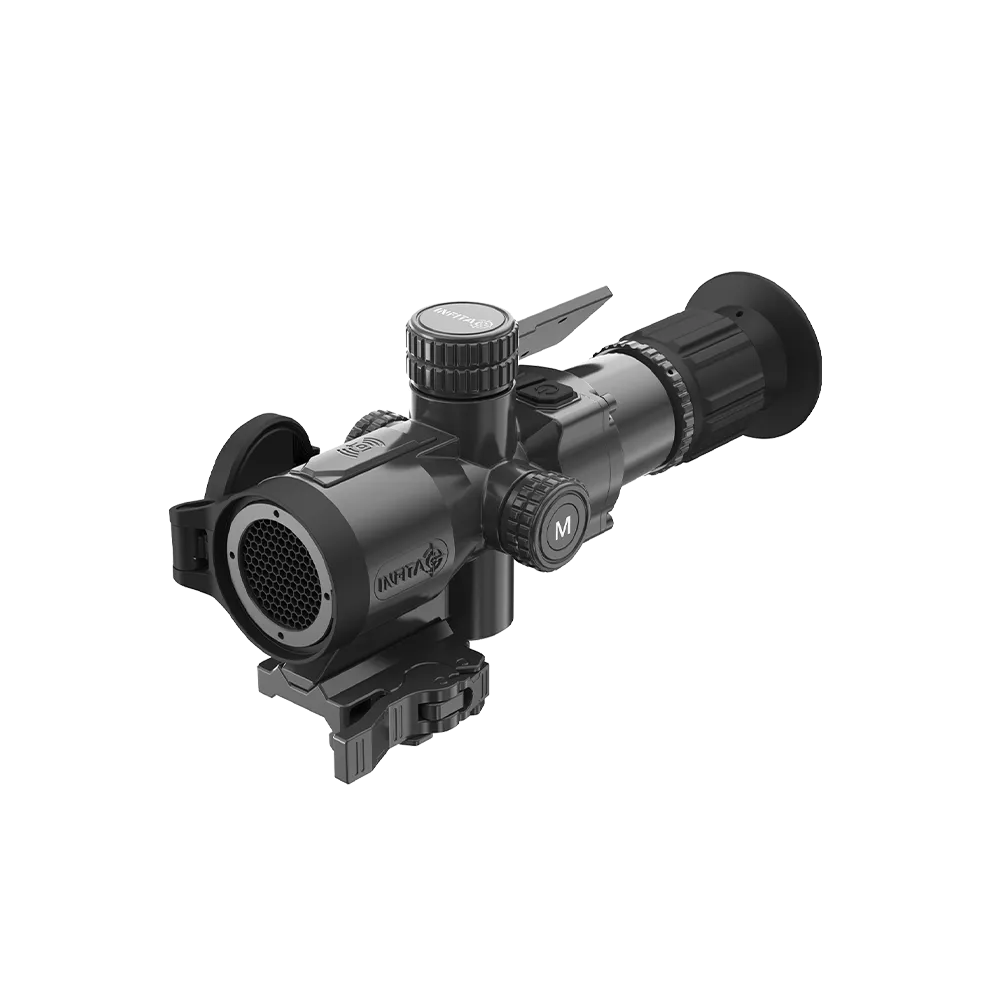
For example, the INFITAC thermal rifle sight lineup includes the compact IOP13 with a 256×192 sensor and the IOL25 with 384×288 thermal detail. The HYDRA HS219 is another compact 256×192 option with a 19mm thermal lens.
Thermal sensitivity, commonly listed as noise-equivalent temperature difference ('NETD'), describes how well the sensor may distinguish small temperature differences. A lower NETD number may help produce better contrast when conditions are difficult, such as cool mornings, damp vegetation, or animals partially hidden by brush.
Having said that, NETD should not be the only specification you use. Display quality, image processing, lens choice, focus, calibration, and your ability to operate the optic may matter just as much in your actual hunting conditions.
Match Base Magnification and Field of View
More magnification is not automatically better.
A lower base magnification and wider FOV may be useful when you are scanning timber, tracking a moving animal, or hunting at shorter distances. A larger lens and higher base magnification may help you read targets farther away, but the image may feel narrower and movement may be harder to follow.
Generally speaking:
- Smaller lenses may provide a wider view and a more compact setup.
- Mid-size lenses may balance reach and field of view for mixed terrain.
- Larger lenses may provide more reach but can add weight and cost.
Digital zoom can make a subject appear larger, but it does not create new sensor detail. When you compare scopes, pay attention to the base image before relying on the highest advertised magnification.
The AnyTime Optics guide to choosing a rifle scope can help you compare magnification, mounting height, reticles, eye relief, and the viewing conditions you expect.
Look at Refresh Rate, Battery Life, and Size
Refresh rate, measured in hertz ('Hz'), affects how smoothly the image updates. A lower refresh rate may be acceptable for a stationary observation, while a higher refresh rate may feel more comfortable when you scan, pan, or follow moving animals.
You should also examine battery performance carefully. Manufacturer runtime figures may be measured under controlled conditions, while cold weather, high screen brightness, frequent recording, and repeated menu use may reduce actual runtime. For a long sit, you may want to compare:
- Advertised runtime versus expected real-world use
- Replaceable batteries versus proprietary battery packs
- Availability of spare batteries
- USB or external power options
- Battery access while wearing gloves
Weight is another practical consideration. A compact thermal scope may help you carry and balance your rifle more comfortably, particularly when you move between stands or carry additional equipment.
Look at the complete system rather than the optic body alone. The mount, battery, lens cover, cables, and accessories may all affect the final weight. AnyTime Optics’ compact thermal scope guide explains why the smallest optic is not automatically the right optic; it still needs to provide enough information for your intended use.
Check Mounting and Zeroing Requirements
Before opening day, confirm that the scope and mount are compatible with your rifle and intended ammunition. You may need to consider the rail pattern, mounting footprint, ring height, recoil rating, eye relief, and clearance around the action or handguard.
A digital thermal scope may use electronic zeroing rather than traditional adjustment turrets. You should follow the specific manufacturer instructions for your model, use a safe and permitted range, and confirm the result with the ammunition you expect to use.
Your pre-hunt setup may include:
- Confirming the rifle is unloaded during installation.
- Checking mount and rail compatibility.
- Setting eye relief from your normal shooting position.
- Applying only the manufacturer’s specified torque.
- Using a heat-visible target where permitted.
- Saving the correct zero profile.
- Confirming the zero again after transport or major changes.
You can review AnyTime Optics’ step-by-step thermal scope mounting and zeroing guide for additional general information. Do not rely on that article as a substitute for your equipment manuals, qualified firearms instruction, professional gunsmithing assistance, or legal advice.
Consider Reticles, Palettes, and Recording
A budget thermal scope may offer several reticle styles and image palettes. White-hot and black-hot palettes are common, while color palettes may help some users notice heat contrast. The best choice may depend on the target, background, weather, and your personal ability to interpret the image.
Controls should be simple enough for you to use in darkness and with gloves. You may want to test:
- Reticle brightness and color
- White-hot and black-hot modes
- Focus and digital zoom
- Automatic or manual calibration
- Screen brightness
- Video recording
- Photo capture
- Menu navigation
Recording can be useful for reviewing your setup, documenting a hunt where lawful, or learning how the optic performs in different conditions. It may also consume storage and battery power, so you should understand how to enable and disable it before you leave for the field.
Is an Integrated Laser Rangefinder Worth It?
An integrated laser rangefinder can provide distance information without requiring you to carry a separate handheld unit. This may be especially useful in open terrain, where shot distances can change quickly.
The added cost may be harder to justify if you hunt mostly in thick woods at short distances or already use a separate rangefinder comfortably. Generally speaking, an LRF becomes more attractive when you regularly need distance information, want fewer separate devices, or prefer to keep your eyes on the optic.
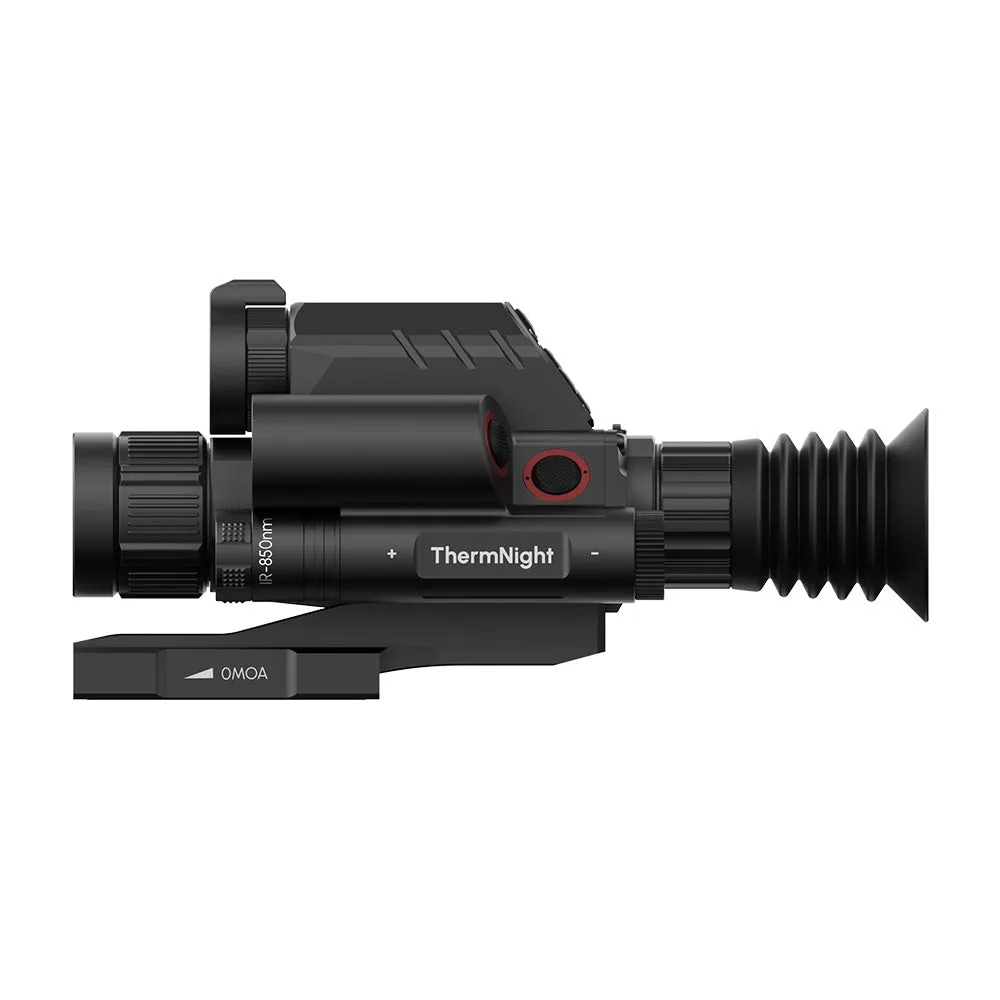
AnyTime Optics’ ThermNight lineup includes compact fused thermal and night vision systems with an integrated LRF and ballistic calculator on listed models. The HYDRA lineup also includes rangefinder-equipped options.
Remember that a rangefinder does not replace responsible target identification, a confirmed zero, knowledge of your equipment, or compliance with applicable hunting laws. Do not rely on this article as legal advice, and seek professional legal counsel when you need guidance about your specific circumstances.
Where AnyTime Optics Fits
AnyTime Optics offers several compact thermal and fused optic options for hunters and firearm enthusiasts.
The HYDRA line is designed as a multi-function thermal platform, with options that may work as a scope, clip-on, or handheld depending on the model and setup. The INFITAC lineup includes compact thermal sights such as the IOP13 and higher-resolution IOL25. The ThermNight offerings combine thermal and night vision functionality, with integrated ranging available on selected models.
Our broader options range from an entry point around $599 to premium units around $2,843, although pricing, inventory, promotions, and configurations may change. If you do not need thermal imaging yet, AnyTime Optics also offers a lower-cost day scope with night vision capability at around $400, which may be a more appropriate starting point for some hunters.
You can compare the current AnyTime Optics product lineup, browse INFITAC compact optics, or contact the team with your rifle, terrain, expected distance, and budget. AnyTime Optics also recently obtained an FFL Class 7 license supporting customized firearms, subject to applicable laws and requirements.
Opening-Day Checklist
Before you head out, you may want to confirm:
- Your selected optic is legal for your location and season.
- The scope is securely mounted.
- The correct zero profile is selected.
- Zero has been confirmed with your hunting ammunition.
- Batteries are charged and spares are packed.
- Focus, palette, magnification, and recording controls are familiar.
- The optic has been tested in conditions similar to your hunt.
- Your target-identification process is clear and appropriate.
- You have reviewed the owner’s manual and applicable regulations.
Having said that, the best budget thermal scope is not necessarily the one with the highest resolution or the most features. It is generally the optic that provides enough detail for your actual hunting distance, remains manageable on your rifle, fits your budget, and gives you controls you can operate confidently.
This article is only a general and high-level explanation. It is not legal advice, and you should not rely on it for decisions about firearms, hunting, thermal optics, night vision, or laser equipment. Confirm your specific requirements with the relevant authorities, manufacturer, qualified professionals, and legal counsel, and much, much more.